


What gallbladder surgery costs in Bangalore
A planned laparoscopic cholecystectomy (gallbladder removal) in Bangalore usually costs about ₹65,000 to ₹1,50,000 as a hospital package. Complicated cases and stones in the bile duct cost more. The table gives indicative 2026 ranges.
| Procedure | Indicative range (2026) |
|---|---|
| Laparoscopic cholecystectomy (planned) | ₹65,000–₹1,50,000 |
| Complicated gallbladder or acute cholecystitis | ₹1,00,000–₹2,20,000 |
| ERCP for bile duct (CBD) stones | Add ₹40,000–₹90,000 |
| Open cholecystectomy | ₹60,000–₹1,30,000 |
Indicative, 2026. Varies by hospital, room category and case. These figures are not Dr. Sanjit Gogoi's fee and not a quote. A written estimate is given after the consultation.
The ranges are wide because a planned operation in a healthy adult with a day or one-night stay is a very different admission from an emergency with an infected gallbladder, several days of antibiotics and an ERCP. If you are not yet sure surgery is needed, read can gallbladder stones go away on their own? or the main page on gallbladder stone surgery.
What is included in the package
Packages differ between hospitals, so ask for the inclusions and exclusions in writing. A typical package for planned laparoscopic cholecystectomy includes:
- Surgeon's, assistant's and anaesthetist's fees
- Operating theatre charges, including the laparoscopic equipment
- Standard consumables such as clips, ports and the retrieval bag
- A room stay of one to two nights, nursing care and routine medicines
- Laboratory examination of the removed gallbladder (histopathology), in some packages
Often not included, or billed separately:
- The consultation and tests done before admission
- MRCP and ERCP, which are separate procedures
- Extra days, ICU care, or a higher room category
- Medicines after discharge and visits after the package period
- Treatment of other conditions found during the stay
Some hospitals offer a fixed package, while others bill item by item. A package gives more certainty, but check what happens if you need an extra day or a change of plan during surgery. Itemised billing can work out lower for a short, straightforward stay, but it is harder to predict.
Factors that change the cost
- Planned or emergency: an emergency admission usually brings extra scans, intravenous antibiotics and a longer stay.
- How inflamed the gallbladder is: acute cholecystitis, a pus-filled gallbladder or a scarred, shrunken one means a longer, more demanding operation, sometimes a drain and more days in hospital.
- Stones in the bile duct: ERCP adds a separate procedure, sometimes with a stent that is removed later.
- Hospital and room category: package rates are usually linked to the room category you choose.
- Disposable instruments: single-use ports, clip applicators or advanced energy devices add to the bill.
- Your health: diabetes, heart or lung disease and obesity may need extra tests, a physician review or closer monitoring.
- Conversion to open surgery: if needed for safety, it usually means a longer stay.
Timing also matters. Once gallstones have started causing attacks, a planned operation at a time that suits you usually costs less than an emergency admission later with cholecystitis, jaundice or pancreatitis. It also lets you arrange leave, family support and insurance approval in advance.
Tests before surgery and their approximate cost
| Test | Why it is done | Approximate cost |
|---|---|---|
| Ultrasound abdomen | Confirms the stones, checks the gallbladder wall and bile duct | ₹1,200–₹2,500 |
| LFT and routine blood tests | Liver function, blood count, sugar, kidney function, clotting | ₹2,000–₹5,000 |
| MRCP (if needed) | Looks for stones in the bile duct | ₹7,000–₹12,000 |
An ECG, chest X-ray or physician review may be added depending on your age and health. If you already have a recent ultrasound and blood reports, bring them; tests are repeated only when they are outdated or do not answer the question.
Insurance and cashless treatment
Most Indian health insurance policies cover laparoscopic cholecystectomy when it is medically necessary. Points to check in your policy:
- Waiting period: gallbladder stones are a named condition in many retail policies, often with a waiting period of 1–2 years. In most policies this applies even to an emergency admission, unless the policy says otherwise. Employer group policies often have shorter or no waiting periods.
- Pre-existing condition: if stones were diagnosed before you bought the policy, a pre-existing disease waiting period may apply.
- Room rent limits: choosing a room above your eligibility can reduce the amount paid on the whole bill, not just the room charges.
- Sub-limits and co-payment: some policies cap specific procedures or ask you to pay a fixed share.
- Non-payable items: some consumables and administrative charges may not be paid by the insurer.
For a planned operation, the hospital's TPA (insurance) desk sends a pre-authorisation request with the doctor's notes and your reports a few days before surgery. For an emergency admission, the insurer usually needs to be informed within a short window, often 24 hours, and the TPA desk helps with this. Approval is always the insurer's decision.
If you pay first and claim later, keep the discharge summary, reports, itemised bills and payment receipts, and submit the claim within your insurer's time limit.
Laparoscopic vs open: is the extra cost worth it?
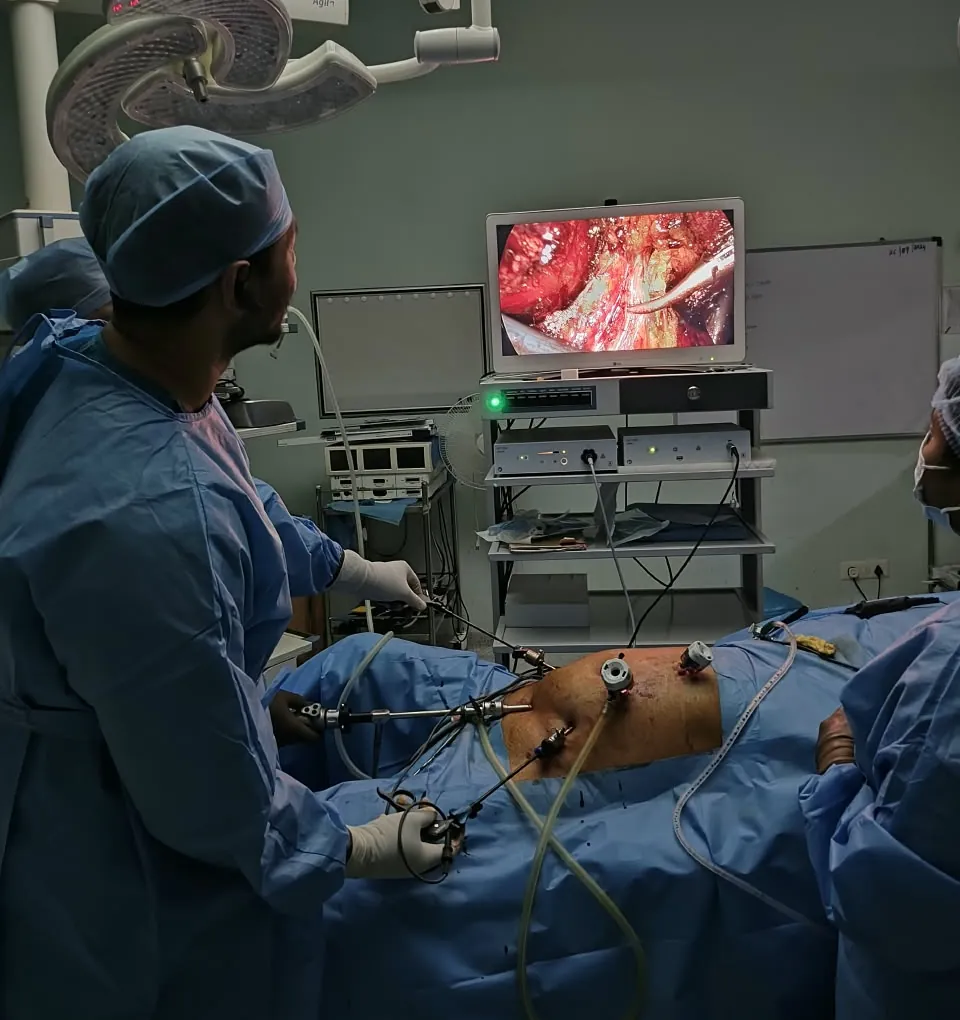
As the table shows, the package price for laparoscopic and open cholecystectomy overlaps, because keyhole surgery usually means a shorter stay that offsets the equipment cost. For most patients, the laparoscopic route is the standard of care, with:
- Less pain after surgery for most patients
- A hospital stay of a day or two rather than several days
- A return to desk work in about one to two weeks, compared with often four weeks or more after open surgery
- Small scars, and a lower risk of wound infection and incisional hernia
Open surgery is still used when laparoscopy is not safe or possible, for example after major previous upper abdominal surgery, with some severe inflammation, or when conversion is needed during the operation. Dr. Sanjit recommends one approach with his reasons, and keyhole surgery is the plan for most patients. Read more about laparoscopic surgery.
How to get an exact estimate
- Share your reports: send your ultrasound, blood test reports or a short note on your symptoms on WhatsApp to +91 99160 26256.
- Consultation: Dr. Sanjit examines you, explains the scan, and tells you whether surgery is advised, how urgent it is and whether further tests such as MRCP are needed.
- Written estimate: the hospital billing team prepares a package estimate for your procedure and room category.
- Insurance check: the TPA desk confirms what your policy is likely to cover and starts pre-authorisation.
Consultations are at SPARSH Hospital, Sarjapur Road (10 am to 5 pm) and the evening clinic in Doddakannelli (5 pm to 8 pm), Monday to Saturday, a short drive from HSR Layout and Bellandur. Book a consultation for a plan and an estimate.
To make the visit useful, bring all your scans and blood reports (old and new), a list of your current medicines, your insurance card or policy details, and a family member if you would like one with you. Questions you have written down are welcome too.
MBBS, MS (General Surgery), MRCS (Edinburgh). General and Minimal Access Surgeon with about 18 years in general, laparoscopic and laser surgery. Consults at SPARSH Hospital, Sarjapur Road (10 am – 5 pm) and his evening clinic in Doddakannelli (5 – 8 pm). KMC Reg. No. 96096. More about Dr. Sanjit